Results for "cluster analysis"

Duke University
Skills you'll gain: Bayesian Statistics, Statistical Hypothesis Testing, Sampling (Statistics), Statistical Inference, Exploratory Data Analysis, Regression Analysis, R (Software), Statistical Reporting, Probability & Statistics, Probability Distribution, Statistical Analysis, Statistical Methods, Statistics, Statistical Software, Data Analysis Software, Data Analysis, Probability, R Programming, Statistical Modeling, Data Visualization
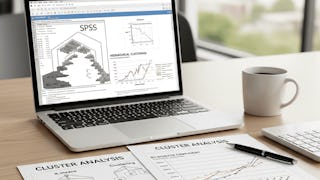
Skills you'll gain: Unsupervised Learning, SPSS (Software), SPSS, Statistical Machine Learning, Applied Machine Learning, Machine Learning, Machine Learning Methods, Statistical Software, Data Preprocessing, Machine Learning Algorithms, Statistical Analysis, Model Evaluation, Data Mining, Data Cleansing, Data Analysis, Statistical Methods, Data Visualization

University of Illinois Urbana-Champaign
Skills you'll gain: Data Mining, Model Evaluation, Algorithms

Skills you'll gain: Power BI, Data Ethics, Data Visualization Software, Data Analysis, Statistical Analysis, Correlation Analysis, Business Intelligence, Analysis, Data Visualization, Statistics, Statistical Methods, Advanced Analytics, Data Analysis Expressions (DAX), Analytics, Data-Driven Decision-Making, Exploratory Data Analysis, Time Series Analysis and Forecasting, Spatial Data Analysis, Scatter Plots, Forecasting

University of California, Irvine
Skills you'll gain: Model Evaluation, Unsupervised Learning, Data Analysis, Regression Analysis, Predictive Modeling, Fraud detection, Correlation Analysis, Scatter Plots
University of Colorado Boulder
Skills you'll gain: Unsupervised Learning, Dimensionality Reduction, Model Evaluation, Exploratory Data Analysis, Algorithms

Skills you'll gain: Pandas (Python Package), Matplotlib, Plot (Graphics), Data Visualization, Data Presentation, Data Preprocessing, Data Manipulation, Data Cleansing, Data Wrangling, Data Transformation, Data Visualization Software, Scatter Plots, Data Import/Export, Data Integration, Code Reusability, Jupyter, Data Analysis, Data Science, Python Programming, Machine Learning

University of Illinois Urbana-Champaign
Skills you'll gain: Data Visualization, Data Visualization Software, Text Mining, Data Presentation, Data Mining, Dashboard, Tableau Software, Plot (Graphics), Dashboard Creation, Natural Language Processing, Unsupervised Learning, Data Mapping, Unstructured Data, Statistical Analysis, Graphing, Big Data, Data-Driven Decision-Making, Analytics, Data Analysis, Statistical Machine Learning
Skills you'll gain: Data Wrangling, Exploratory Data Analysis, Model Evaluation, Data Cleansing, Data Preprocessing, Data Manipulation, Data Analysis, Model Training, Scatter Plots, Statistical Analysis, Predictive Modeling, Regression Analysis, Statistical Methods, Data Transformation, Data Import/Export, Descriptive Statistics, Box Plots, Model Optimization, Data Visualization, Python Programming

Skills you'll gain: Pandas (Python Package), Pivot Tables And Charts, Data Manipulation, Data Import/Export, NumPy, Business Reporting, Jupyter, Data Visualization, Data Wrangling, Microsoft Excel, Data Transformation, Data Analysis Software, Data Analysis, Data Cleansing, Analytics, Business Analytics, Python Programming, Data Preprocessing, Performance Analysis, Numerical Analysis

Skills you'll gain: Data Storytelling, Qualitative Research, Market Research, Quantitative Research, Data-Driven Decision-Making, Benchmarking, Data Presentation, Descriptive Statistics, Competitive Analysis, Analytical Skills, Brand Awareness, Research Design, Market Dynamics, Data Analysis, Customer Analysis, Data Collection, ChatGPT, Data Analysis Software, Microsoft Excel, R Programming


Rice University
Skills you'll gain: Statistical Hypothesis Testing, Microsoft Excel, Pivot Tables And Charts, Regression Analysis, Statistics, Descriptive Statistics, Probability & Statistics, Graphing, Spreadsheet Software, Probability Distribution, Statistical Analysis, Statistical Modeling, Statistical Inference, Excel Formulas, Business Analytics, Data Analysis, Data Presentation, Model Evaluation, Statistical Methods, Sample Size Determination
Best Cluster Analysis courses from EDUCBA
Top-rated Cluster Analysis courses offered by EDUCBA on Coursera.
- SPSS: Apply & Evaluate Cluster Analysis TechniquesEDUCBABeginner1 - 4 WeeksEDUCBA
- Data Analysis with NumPy and PandasEDUCBABeginner1 - 3 MonthsEDUCBA
Best Cluster Analysis certificate programs
Earn a certificate in Cluster Analysis from top universities and companies.
- Data Analysis with RDuke UniversityBeginner3 - 6 MonthsSpecialization
- Data Analysis with Pandas and PythonPacktIntermediate3 - 6 MonthsSpecialization
- Data MiningUniversity of Illinois Urbana-ChampaignIntermediate3 - 6 MonthsSpecialization
Best Cluster Analysis courses for beginners
Top-rated beginner-friendly Cluster Analysis courses with no prerequisites.
- Visualization for Data Analysis with Power BIMicrosoftBeginner1 - 4 WeeksNo prerequisites
- Business Statistics and AnalysisRice UniversityBeginner3 - 6 MonthsNo prerequisites










